Measure how your brand is perceived in the eyes of consumers — awareness, image, core values and loyalty. Identify strengths and weaknesses compared with competitors and a foundation for the communication strategy.
5–15×
Return
Typical ROI on a consumer brand study through correct positioning, campaign choice and channel mix.
78%
The decision is emotional
Of consumer decisions are driven by emotional factors — and rationalised afterwards. We capture both layers.
1,000+
Respondents typically
For B2C panels with representative distribution across demographics, region and purchase behaviour.
Sample from a delivery
What a positioning analysis looks like
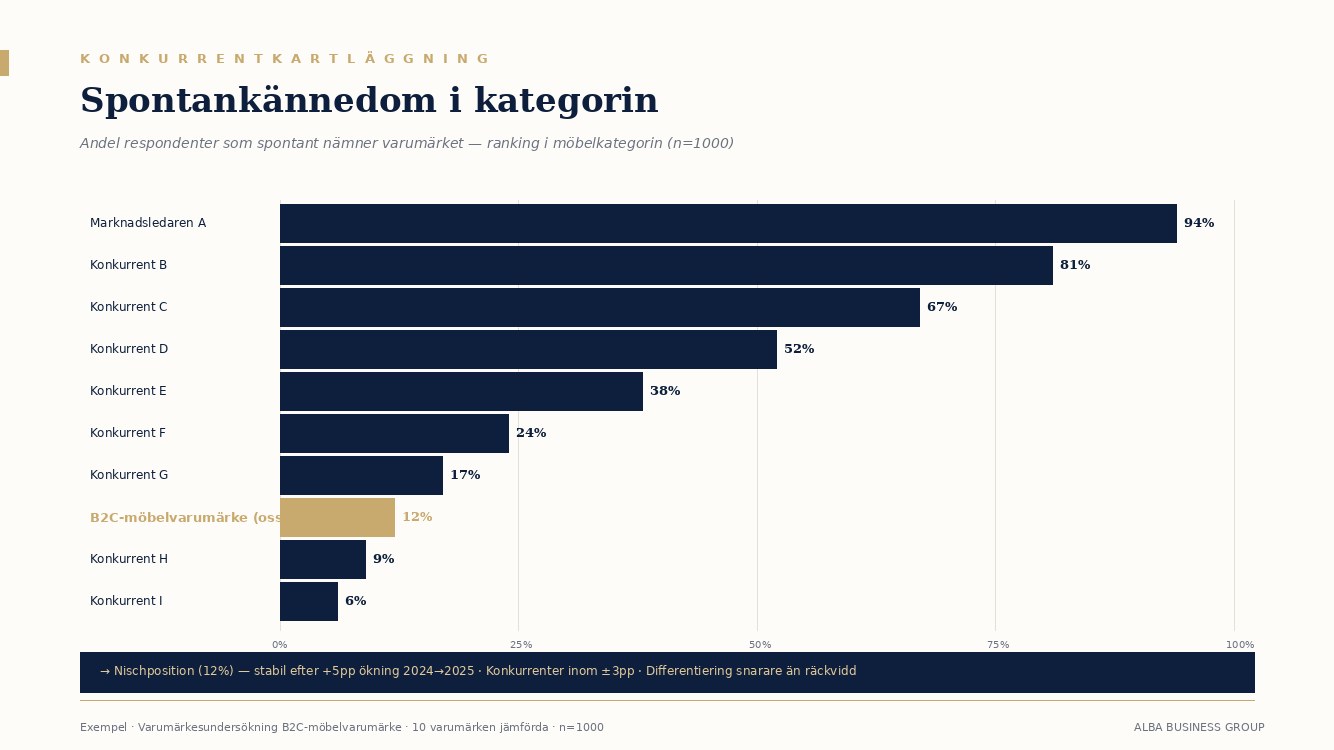
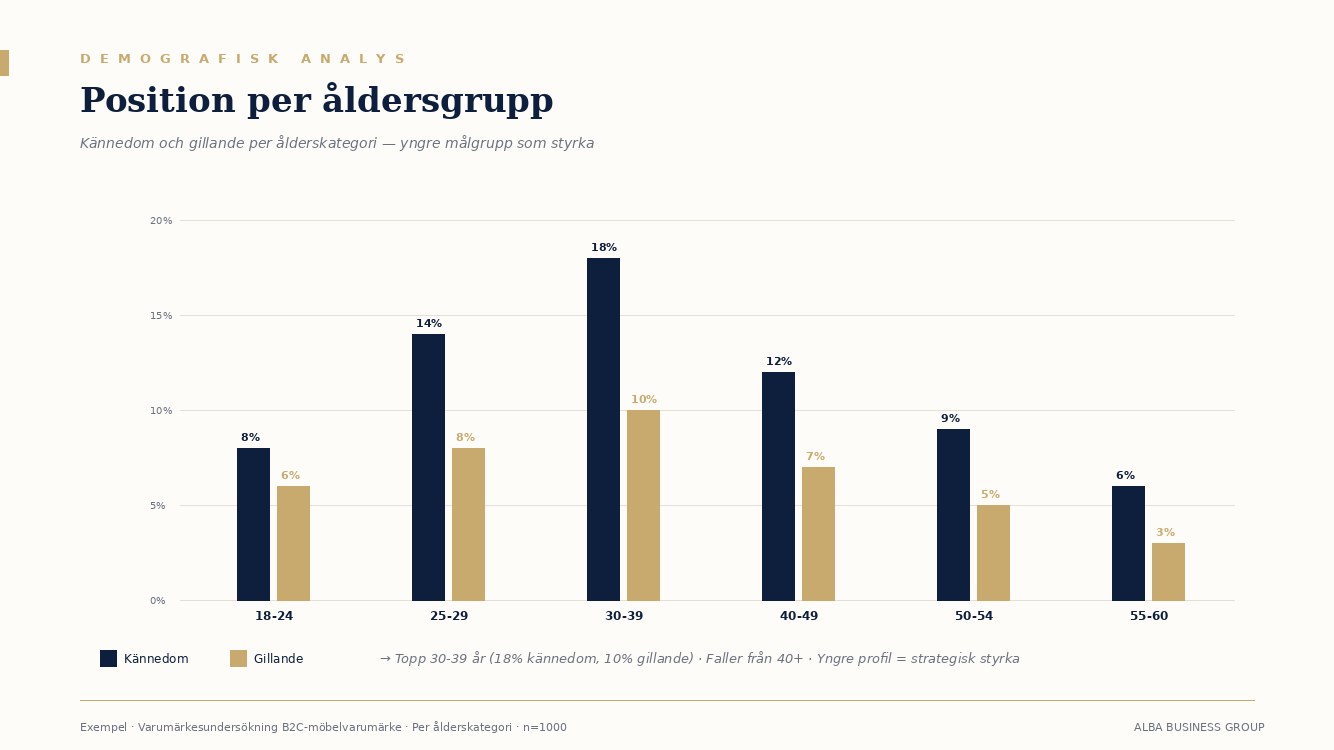
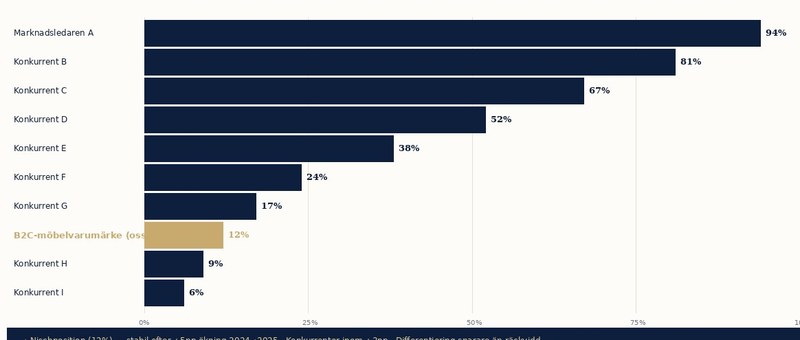
Awareness, image and preference measured against 6 competitors — broken down by demographics and purchase behaviour. This is an actual delivery to a consumer brand (anonymised).
What you get
A complete picture of your brand position
We always start by understanding your business goals — then we choose method and design. The result is not just numbers but concrete action recommendations ranked by expected impact.
Awareness
Spontaneous and aided. Top-of-mind share in the category plus aided awareness against specific competitors. Broken down by demographics, region and purchase behaviour — so you can see where you have coverage and where there are blind spots.
Top-of-mindAidedPer demographic
Image & associations
What are you associated with? Which adjectives come to the consumer's mind? Per attribute dimension (quality, price, innovation, sustainability, tradition). Per core value and compared with competitors — to see where you stand out.
What drives the choice? Driver analysis of rational vs emotional factors. When choosing between your brand and a competitor — what tips the decision? Price, quality perception, trust, value alignment?
Driver analysisRational vs emotionalDecision factors
Loyalty & recommendation
Do they stay — or switch? Measurement of repurchase frequency, NPS and what lies behind a switch. Identifies loyalty drivers so you can strengthen the relationship with existing customers.
NPSRepurchase frequencySwitching analysis
Free guide · PDF
The complete brand guide for consumer
18 min · 22 pages
Want to read more first?
The complete brand guide for consumer
An 18-minute read written by Johan Asklund. Awareness, image, preference and loyalty — how to design consumer panels that capture both rational and emotional drivers. Question examples and driver analysis templates included.
The consumer purchase journey — from category awareness to advocacy
B2C consumer brands compete on several layers at the same time. We measure all touchpoints in the consumer's decision process — from first exposure to social media sharing.
01 · Phases in the consumer journey
Measurement points across the entire journey
We follow every phase — adapted to your business model — and measure both quantitatively and qualitatively.
01Category awareness
02Spontaneous awareness
03Aided awareness
04Consideration
05First choice (top-of-mind)
06Value words & associations
07Functional image
08Emotional image
09Price/quality perception
10Purchase intent
11Repurchase frequency
12Recommendation (NPS)
13Advocacy & sharing
14Switching reasons
02 · Overall metrics
Three KPIs that lead
Standardised key figures — comparable over time and against external benchmarks.
TOM
Top-of-mind — spontaneous awareness as the first brand mentioned in the category.
Preference share
Share who choose you first in a hypothetical purchase (first-choice share).
NPS
Recommendation willingness — promoters minus detractors.
03 · What you get
Concrete — not just an average score
For every insight we deliver:
→ Positioning analysis
Your core values and image compared with 5–10 competitors — visualised.
→ Driver analysis
Which factors drive purchase intent most strongly — emotional vs rational.
→ Per segment
Breakdown by demographics (age, gender, household) and behaviour (purchase frequency, channel preference).
→ Switching analysis
Why customers leave for competitors — and what would have prevented it.
What the delivery looks like
Examples from an actual report
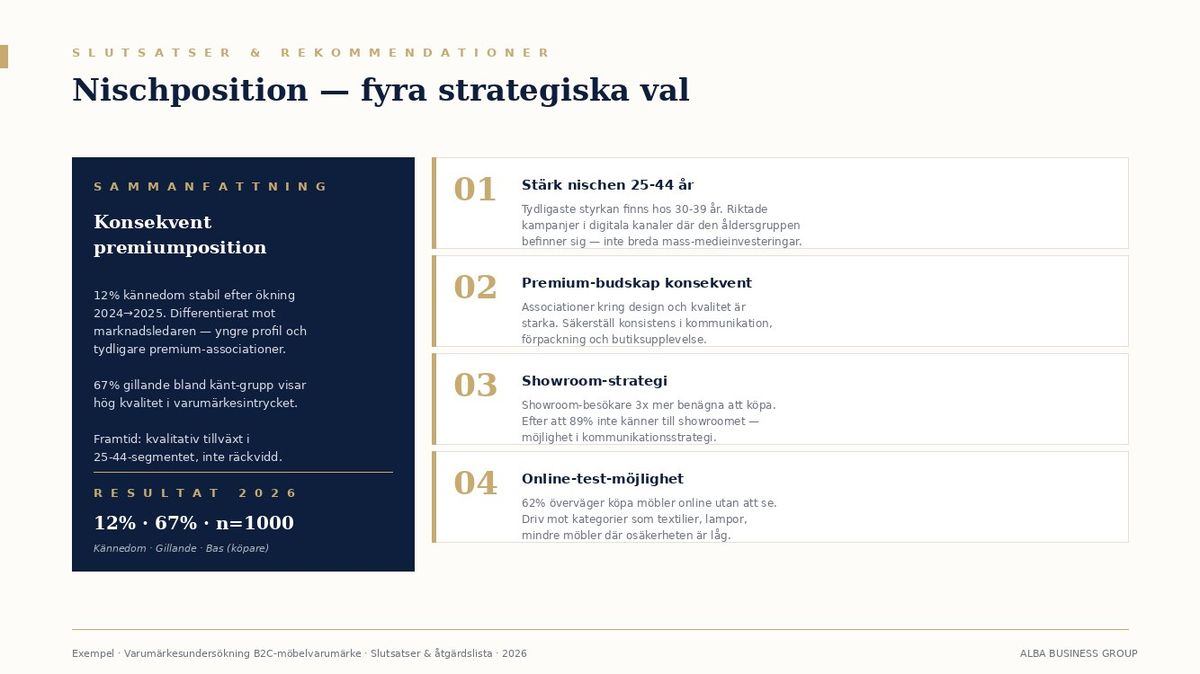
Screenshots from a brand study for a B2C furniture brand (anonymised). 1,000 respondents through a consumer panel, 10 brands compared. Delivered as Word + PDF + PowerPoint with executive summary, competitor mapping, demographic breakdowns and concrete strategic choices.
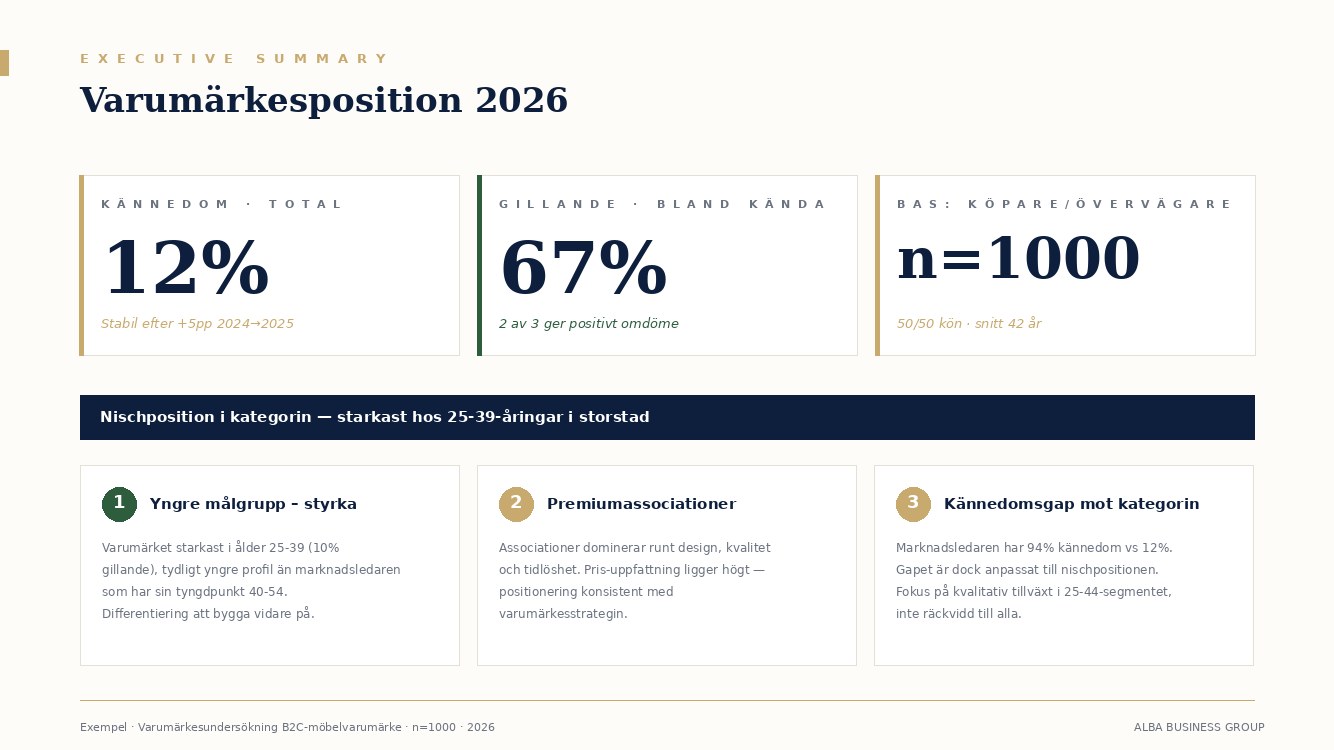
Executive summaryAwareness, liking and target group on a single page — plus three short headline findings for management.Competitor mappingSpontaneous awareness ranked against 10 brands in the category — so you can see exactly where you stand relative to others.Per age groupBreakdown by demographics — identifies where the brand is strongest and where there is strategic strength or a gap.Strategic choicesFour concrete strategic choices ranked by impact — for decisions, not for filing.
The images are from an actual delivery to a B2C furniture brand in 2026 (n=1,000, 10 brands compared). Customer name, brand and respondent data have been removed or masked in the example.

Who you talk to
Johan Asklund
Founder & CEO · Alba Business Group
30+ years of experience in B2B research and surveys. Has run Alba since 2005 (formerly TradeWell Group). Personal contact on every project — no project managers swapped out mid-engagement.
"Alba's NPS study identified three churn risks we had missed. Two customers were saved before the quarter was out."
"We knew we were number two in the category. The study showed we were number one among 25–34 year-olds — the target group we had not been communicating to. The entire media mix was reworked."
Want to know what consumers actually think about you?
Book 15 minutes and we will discuss your current positioning, your core competitors and how we design the study so you get a basis to act on, not just numbers to report.
Frequently asked questions about Brand Research B2C
What is a brand research study for B2C?
Structured measurement of how your brand is perceived by consumers — awareness, image, preference, loyalty and purchase intent. Difference vs B2B: large consumer panels (typically 500–2000 respondents), demographic segmentation, and focus on emotional brand resonance rather than rational attributes.
What is the difference vs B2B brand measurement?
B2C brands build on emotions, lifestyle and identification — B2B on functionality, security and trust. B2C measurement requires larger panels (for statistical confidence in demographic segments), more focus on image attributes around feeling and story, and more frequent integration of qualitative research (focus groups, ethnographic).
How large consumer panels are needed?
For national representativeness: at least 500 respondents, preferably 1000. For segmentation on age × gender × region: 1500–3000. For niche segments (premium, urban affluent, etc.): quota-based design with 200–400 in the niche plus reference panel.
How often should consumer brand be measured?
Annually for stable markets; semi-annually during ongoing campaigns or launch; quarterly during product introduction or PR crisis. Continuous brand tracking (rolling weekly data) typically only pays off for large consumer companies with multi-million media investment.
Can we get demographic and regional breakdowns?
Yes. Standard includes age × gender × region. With larger panel also household income, education, housing type, lifestyle segments. We can also report per specific cities or regions with sufficient sample size.
Brand awareness vs brand resonance — what is the difference?
Awareness is knowing the brand exists (unaided/aided recall). Resonance is the brand meaning something — the consumer having emotional connection, identifying with, and actively choosing it. Resonance predicts price-premium and loyalty more strongly than pure awareness. We measure both.
What do we get delivered?
Brand health report (PDF + presentation) with awareness funnel, image mapping, preference, NPS, demographic segmentation, brand resonance index and competitive position. Plus 90-minute workshop with marketing leadership translating results to strategy.
What does a B2C brand research study cost?
Three packages: Basic 55 000 kr / €4 950, Standard 85 000 kr / €7 650, Extended 145 000 kr / €13 050. Calculate exact scope and price →
Arken ZooAtea SverigeChalmersConsilium Safety GroupDäckskiftarna i SverigeEdsbyn SenabElda Butiken i SverigeAutomotive industry (under NDA)HagabadetHusqvarnaHusqvarna Construction ProductsICANIWILLIHM Business SchoolIOGT-NTO/MiljonlotterietJohnson Matthey FormoxJotun SverigeLuna SverigeMarbodal / NobiaNetOnNetNobia Svenska KökPacsOn InternationalPerstorpRowico HomeStena MetallSvedbergs i DalstorpSvenska Frimurare OrdenTikkurila SverigeTrelleborg Wheel SystemsUnicarriers Europe / AtletWayne och Margareta's CoffeeWoodyZeppelin Energy RentalArken ZooAtea SverigeChalmersConsilium Safety GroupDäckskiftarna i SverigeEdsbyn SenabElda Butiken i SverigeAutomotive industry (under NDA)HagabadetHusqvarnaHusqvarna Construction ProductsICANIWILLIHM Business SchoolIOGT-NTO/MiljonlotterietJohnson Matthey FormoxJotun SverigeLuna SverigeMarbodal / NobiaNetOnNetNobia Svenska KökPacsOn InternationalPerstorpRowico HomeStena MetallSvedbergs i DalstorpSvenska Frimurare OrdenTikkurila SverigeTrelleborg Wheel SystemsUnicarriers Europe / AtletWayne och Margareta's CoffeeWoodyZeppelin Energy Rental